Hawaiian cocktails are more than just drinks - they're a glimpse into the islands' history and culture. From the Mai Tai to the Chi Chi, each cocktail tells a story of Hawaii’s evolution as a tropical paradise. Here's a quick look at five iconic Hawaiian cocktails, their origins, and where you can enjoy them on Maui:
- Mai Tai: Born in California, this rum-based classic gained a fruity twist in Hawaii. Modern versions, like those at Monkeypod Kitchen, feature macadamia nut orgeat and passionfruit foam.
- Blue Hawaii: Created in 1957 by Harry Yee, this vibrant blue drink embodies the tropical dream. It's widely available at Maui's resorts and tiki bars.
- Lava Flow: A blend of coconut, pineapple, and strawberry, this visually striking cocktail represents Hawaii's volcanic beauty.
- Tropical Itch: Another Harry Yee creation, this bold drink is known for its wooden backscratcher garnish.
- Chi Chi: A vodka-based cousin of the Piña Colada, this creamy drink became popular in the 1970s.
For the best experience, visit Maui's oceanfront spots like Monkeypod Kitchen, Duke's Beach House, or Māla Ocean Tavern. These venues offer both classic recipes and modern variations using local ingredients like Ko‘hana rum and lilikoi. Whether you prefer a traditional Mai Tai or a layered Lava Flow, Maui’s cocktail scene has something for everyone.
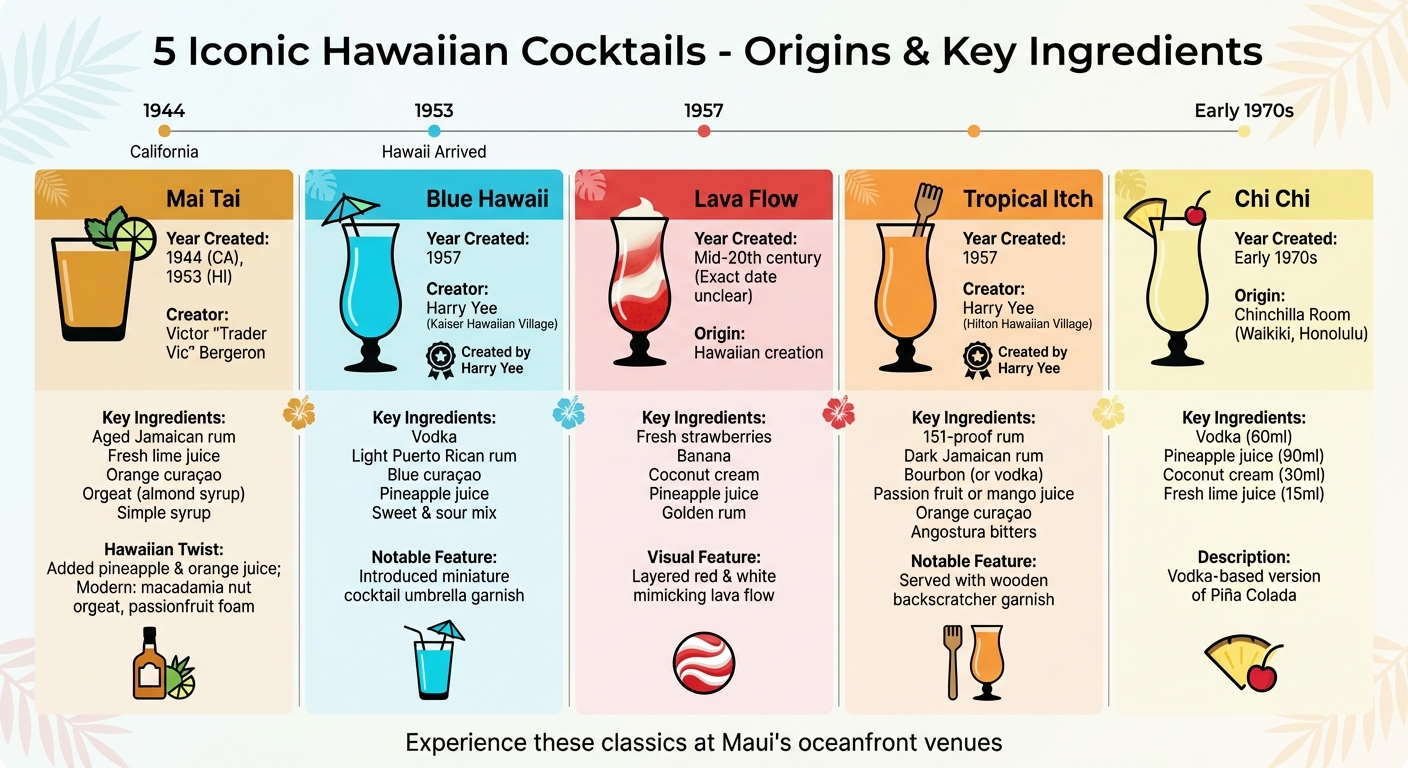
5 Iconic Hawaiian Cocktails: Origins, Ingredients & History Timeline
1. Mai Tai
Historical Origin
The Mai Tai has its roots in Oakland, California. Back in 1944, Victor "Trader Vic" Bergeron crafted this iconic cocktail, though a similar drink called the "Q.B. Cooler" had been created earlier in 1933 by Don the Beachcomber. This sparked a rivalry that came to define tiki culture as we know it.
The drink's journey to Hawaii began in 1953 when the Matson Company hired Bergeron to create a cocktail menu for the Royal Hawaiian and Moana hotels. Over time, bartenders in Hawaii added pineapple and orange juice to the mix, giving birth to the sweeter, Hawaiian-style Mai Tai. This version gained even more fame after being featured in Elvis Presley's 1961 film Blue Hawaii. By 1959, the Mai Tai was already celebrated as Honolulu's "top tourist tantalizer".
The evolution of the Mai Tai - from its tart, rum-forward origins to the sweeter, fruitier Hawaiian version - highlights its adaptability and enduring appeal.
Key Ingredients
The original Mai Tai was a bold, tart combination of aged Jamaican rum, fresh lime juice, orange curaçao, orgeat (almond syrup), and simple syrup. Bergeron's recipe specifically called for 17-year-old J. Wray & Nephew rum, a detail that added a touch of exclusivity. The cocktail's name comes from the Tahitian word maitaʻi, meaning "good" or "the best", reportedly exclaimed by a Tahitian friend of Bergeron after tasting it.
The Hawaiian version took a sweeter approach, blending light and dark rums with pineapple and orange juice, often topped with a float of dark rum. At Monkeypod Kitchen in Wailea, they’ve taken it a step further by incorporating house-made macadamia nut orgeat and a honey-lilikoi (passionfruit) foam, adding a modern, tropical twist.
Today, the Mai Tai continues to evolve, with creative versions popping up across Maui that bring fresh perspectives to this timeless classic.
Availability in Maui (Post-2023 Verified)
Monkeypod Kitchen in Wailea remains a standout destination for Mai Tais, thanks to its inventive touches like the honey-lilikoi foam. For those craving a more traditional experience, asking for a "scratch" Mai Tai - made with fresh, high-quality ingredients instead of pre-made mixes - offers a taste closer to Bergeron's original creation. Across Maui, you’ll find a variety of interpretations, ensuring there’s a Mai Tai for every palate.
sbb-itb-dfba65a
2. Blue Hawaii
Historical Origin
The Blue Hawaii cocktail was born in 1957 at the Kaiser Hawaiian Village (now the Hilton Hawaiian Village Waikiki Beach Resort) in Honolulu. It was created by Harry Yee, the head bartender, after a sales rep from the Dutch distiller Bols requested a drink showcasing their blue curaçao liqueur. Harry Yee named the drink after the title song from Bing Crosby's 1937 film Waikiki Wedding. Fun fact: Yee’s creation also introduced the now-iconic miniature cocktail umbrella as a tropical garnish staple.
"Yee invented drinks to give the public what they wanted - a tourist dream of Hawaii in a glass - which later shaped mainland Americans' perception of drinks culture on the Islands."
– Dylan Garret, Editorial Director, Food & Wine
This cocktail not only defined tiki culture but also set the stage for its evolution over the years.
Key Ingredients
The original Blue Hawaii recipe is a vibrant mix of vodka, light Puerto Rican rum, blue curaçao, pineapple juice, and sweet and sour mix. These days, bartenders often swap out the bottled sweet and sour mix for fresh lime juice and simple syrup to enhance the flavor. The blue curaçao gives the drink its unmistakable neon-blue color and a subtle orange note, while the pineapple and lime juices bring a refreshing tang. To maintain the drink's signature appearance, bartenders let the pineapple juice settle to prevent any yellow tint from dulling the vibrant blue.
It’s worth noting that the Blue Hawaii is different from the Blue Hawaiian, which uses cream of coconut instead of sweet and sour mix.
Availability in Maui
Maui's cocktail scene embraces both the classic and updated versions of the Blue Hawaii. You’ll find this iconic drink featured at resorts and tiki bars across the island. Most well-stocked bars can whip up an authentic version, while craft cocktail spots often offer fresh, creative takes using hand-squeezed juices. Whether you're lounging by the beach or enjoying a night out, the Blue Hawaii is a must-try for anyone visiting Maui.
3. Lava Flow
Historical Origin
The Lava Flow adds a fruity, visually striking twist to Hawaii’s cocktail repertoire. Though its exact origins are a bit murky compared to classics like the Mai Tai, this drink is undeniably rooted in Hawaiian culture. Essentially, it’s a creative spin on the Piña Colada, combining the creamy richness of coconut with the vibrant flair of a strawberry daiquiri, layered together in one glass. Interestingly, outside of Hawaii, it’s sometimes called the "Miami Vice". This cocktail reflects a shift in Hawaiian drink preferences - from the elaborate Tiki-style mixes of the mid-20th century to sweeter, frozen drinks that became popular later on. Its layered flavors and eye-catching presentation embody this evolution.
Key Ingredients
The Lava Flow’s signature look and taste come from its carefully chosen ingredients: fresh strawberries (for that bold red "lava" effect), ripe banana (adding a creamy sweetness), coconut cream (for a luscious texture), pineapple juice (bringing a tangy brightness), and golden rum as its boozy backbone. The ingredients are blended into a smooth, slushy consistency, creating a drink that’s as pleasing to the eye as it is to the palate.
"If a Piña Colada spent some quality time with a Strawberry Daiquiri, the result might be a Lava Flow. Quite unlike any other concoction at the bar, this refreshing cocktail, when prepared with coconut milk and blended properly, simulates the flow of molten lava of the Hawaiian Islands." – Erica Karlin, Koloa Landing Resort
What truly sets this drink apart is its presentation. The red strawberry layer swirls through the creamy white coconut and pineapple mixture, mimicking the dramatic flow of lava against Hawaii’s volcanic backdrop.
Availability in Maui
The Lava Flow has become a staple of Maui’s vibrant cocktail scene. You’ll find it served at numerous resorts and beachside bars across the island. Popular spots like Monkeypod Kitchen in Wailea and Ka'ana Kitchen are known for their fresh, locally-inspired takes on this tropical favorite. If you’re looking for more options, check out the Maui Oceanfront Dining Directory 2026 for an updated list of venues offering creative spins on this iconic drink.
4. Tropical Itch
Historical Origin
The Tropical Itch holds a special place in Hawaiian cocktail history. Created in 1957 by Harry Yee, the head bartender at the Hilton Hawaiian Village, this drink emerged as a response to tourists' requests for a distinctive Hawaiian beverage. It quickly became a standout in the tiki cocktail scene, thanks in part to its playful garnish - a wooden backscratcher. As Martha Cheng notes:
"Harry Yee, who served as Hilton Hawaiian Village's head bartender for 30 years, created some of the tiki scene's most iconic drinks. He was also... the first to stick a backscratcher in a drink of his own invention, aptly named the Tropical Itch."
Yee's creativity didn't stop there - he also introduced other now-classic tropical garnishes like paper umbrellas and Vanda orchids, shaping the visual appeal of tiki culture.
This fun backstory perfectly complements the drink's bold and spirited flavor profile.
Key Ingredients
The original 1957 recipe is a robust mix of 151-proof rum, dark Jamaican rum, and bourbon (or vodka, depending on the variation). To balance the punch of the spirits, it includes fruit juice - either 8 oz of passion fruit or 6 oz of mango. Orange curaçao (or Grand Marnier) brings a layer of richness, while a dash of Angostura bitters adds a spicy kick. Traditionally, the Tropical Itch is served in a Hurricane glass packed with crushed ice for a refreshing finish.
Availability in Maui
While the authentic Tropical Itch continues to be served at the Hilton Hawaiian Village on Oʻahu, Maui offers its own spin on tiki culture. Upscale spots in Wailea are known for crafting inventive tiki cocktails that pay homage to classics like the Tropical Itch. For the latest recommendations, check out the Maui Oceanfront Dining Directory 2026, which features updated venues post-2023. Like other iconic drinks such as the Mai Tai and Lava Flow, the Tropical Itch showcases Hawaii's ability to blend tradition with creative flair, a hallmark of Maui's evolving cocktail scene.
5. Chi Chi
Historical Origin
The Chi Chi cocktail first made its mark in the early 1970s at the Chinchilla Room in Waikiki, Honolulu. As vodka started to outshine rum in popularity, bartenders crafted this drink as a lighter twist on the Piña Colada, catering to tourists seeking a breezy, tropical experience. The Chi Chi quickly became a hallmark of Hawaiian resort culture during the '70s and '80s, often served poolside at hotels across the islands. Olivia Bennett describes it well:
The Chi Chi substituted vodka for rum, catering to guests who wanted the same refreshing sweetness but with a neutral spirit.
Unlike the intricate tiki drinks of earlier years, the Chi Chi embraced simplicity. Bennett refers to it as a "postcard of Americanized tropical fantasy" - creamy, straightforward, and designed to please a wide audience. Its recipe reflects this streamlined approach.
Key Ingredients
The traditional Chi Chi combines 60 ml of vodka, 90 ml of pineapple juice, 30 ml of coconut cream (not coconut milk), and 15 ml of fresh lime juice. These ingredients are blended with ice until smooth and topped with a pineapple wedge and a maraschino cherry for garnish. In Hawaii today, you might find variations that include passionfruit (liliko'i), mango, or even matcha. Still, the original recipe remains a favorite, offering a refreshing and uncomplicated taste of the tropics.
Availability in Maui
As of June 2025, the Chi Chi continues to be a go-to option at Hawaiian resort and poolside bars. In Maui, upscale spots like Monkeypod Kitchen Wailea and Ka'ana Kitchen are known for serving expertly crafted tropical cocktails. The Chi Chi embodies Maui's combination of tradition and modern flair, capturing the island's vibrant, tropical essence. For updated recommendations on oceanfront venues with tropical drink menus, check out the Maui Oceanfront Dining Directory 2026, which provides verified listings and detailed beverage options.
The History Of Tiki Cocktails | Proof Podcast From America's Test Kitchen
Where to Find These Cocktails in Maui
Experience the best of Hawaiian cocktails at Maui's oceanfront spots, where the island's cocktail traditions meet a touch of modern flair. For the latest updates on operating restaurants, beverage offerings, and hours, the Maui Oceanfront Dining Directory 2026 is an invaluable resource - especially as many downtown Lahaina establishments remain closed.
One standout venue is Māla Ocean Tavern, located on the north end of Front Street near the Cannery Mall. Open daily from 8:00 AM to 9:00 PM (with the bar staying open until 10:00 PM), this spot offers a vibrant happy hour with live music from 2:00 PM to 4:00 PM. Māla has been nominated for the 2026 'Aipono Awards in categories like Restaurant of the Year and Best Fish & Seafood. It also hosts events like the Lahaina Food & Wine Festival, scheduled for February 18–22, 2026. Reservations are strongly recommended, though walk-ins are welcomed when space allows.
If you're exploring beyond Lahaina, the Kā'anapali resort area offers an equally delightful cocktail scene. Popular spots like Duke's Beach House, Hula Grill, and Leilani's on the Beach feature full bars serving island favorites such as Mai Tais and Lava Flows, all paired with stunning beachfront views.
"We want people to come back to Lāhainā. We want the support, we want to employ people, we want to be busy and we want to create jobs."
- Rob Farrell, Co-owner, Coco Deck Kitchen + Bar
For those visiting north Lahaina, parking at designated areas like the Cannery Mall is encouraged to avoid residential zones along Front Street. The Maui Oceanfront Dining Directory 2026 also includes up-to-date parking details, accessibility information, and reservation links, making it easier to enjoy Maui's signature cocktails while contributing to the island's recovery efforts.
Conclusion
These iconic cocktails serve as a bridge between Hawaii's storied past and its lively present. Each of these five drinks tells a tale of Hawaii's history, from the Golden Age of Tiki to the post-war tourism boom that helped shape the islands into a tropical destination for visitors from across the U.S. The Mai Tai, for example, has undergone a transformation - from Victor Bergeron's rum-centric original to the pineapple-infused Hawaiian twist - showing how the islands made the drink their own.
Savoring these cocktails at Maui's oceanfront restaurants offers more than just a taste of history - it’s an experience that ties you to the island's culture. Picture this: a stunning Pacific sunset, live music in the background, and a perfectly balanced Mai Tai in hand. It’s a slice of the tropical charm that has drawn people to Hawaii since the mid-20th century.
For those looking to sip on these classics, the Maui Oceanfront Dining Directory 2026 is a handy guide. Whether you’re after traditional recipes that stick to the original ingredients or modern spins featuring local Ko Hana rum and macadamia nut orgeat, this directory points you to the best oceanfront spots to enjoy these historic cocktails. Make your visit to Maui unforgettable with a taste of its rich cocktail heritage.
FAQs
What’s the difference between a classic Mai Tai and a Hawaiian Mai Tai?
The main distinction lies in their origins and ingredients. The classic Mai Tai, born in California during the 1940s, is made with rum, Curaçao, lime juice, and orgeat syrup. On the other hand, the Hawaiian Mai Tai reflects Hawaii's tiki culture, using similar ingredients but often incorporating island-inspired garnishes or local spirits. Its presentation and flavors lean heavily into tropical vibes.
How is a Blue Hawaii different from a Blue Hawaiian?
The Blue Hawaii cocktail was first crafted in 1957 by bartender Harry Yee at the Hilton Hawaiian Village in Waikiki. This tropical drink features a mix of vodka, light rum, pineapple juice, blue curaçao, lime juice, and sugar, creating a vibrant and refreshing flavor profile.
The Blue Hawaiian, often confused with its predecessor, is a variation that typically sticks to the core ingredients of rum, blue curaçao, and pineapple juice. However, it may include slight differences in ingredients or proportions, giving it its own unique twist.
Where can I find these cocktails on Maui that are currently open?
You can sip on Hawaiian cocktails at Tikehau Lounge in Kihei, a spot celebrated for its standout drinks. Resorts like the Four Seasons Resort Maui Wailea and 1 Hotel Hanalei Bay also serve up tropical cocktails crafted with local spirits. Before heading out, it’s a good idea to confirm availability.